Friday, September 17, 2010

New York City Street Photography: Respecting the Genre


I suppose in order for photos to be categorized as "Street Photography," there are two necessary elements, the city and the people in it.

Street photography without people may fall into the genre of Landscape Photography or something else.

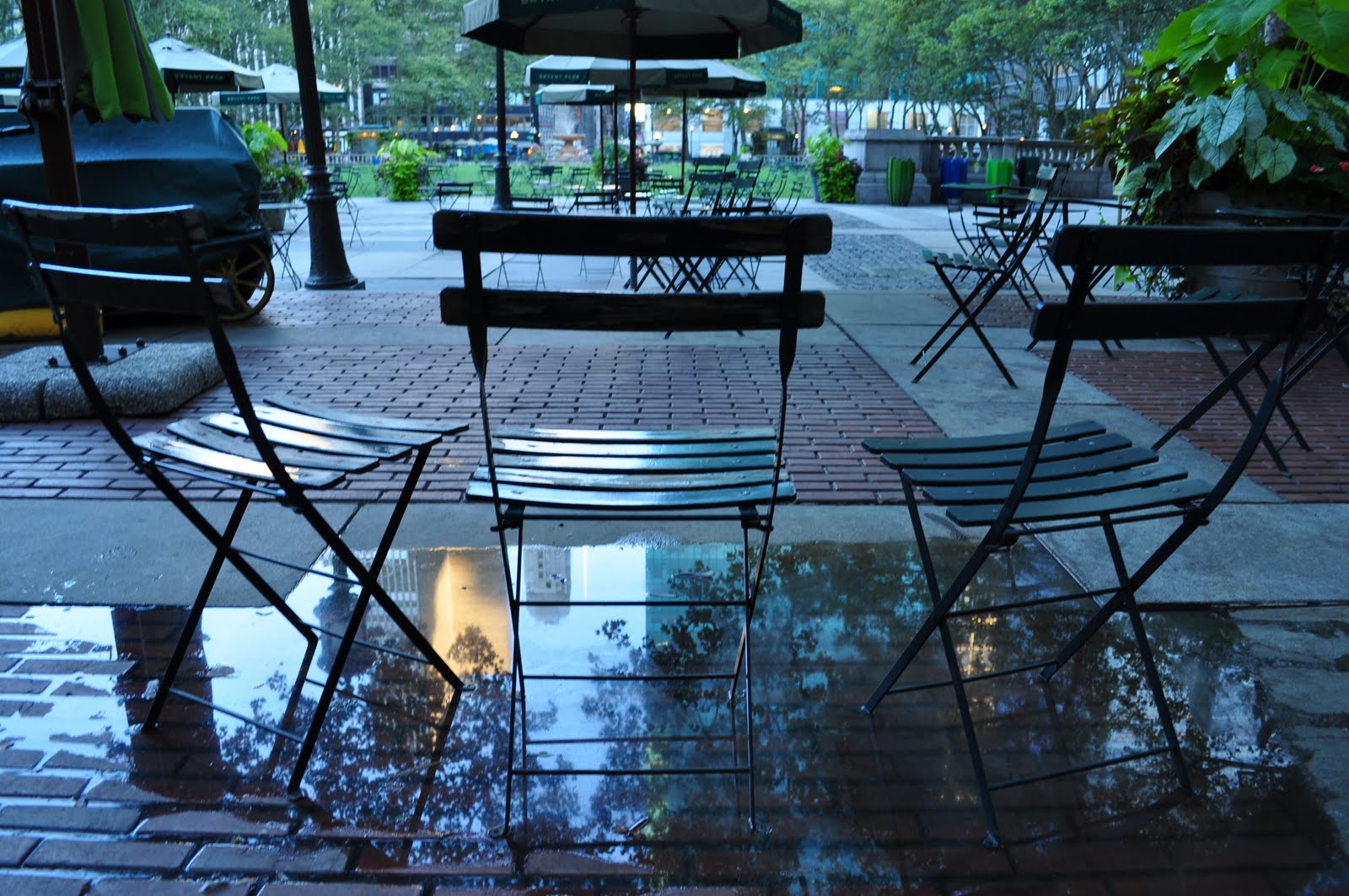
When I'm shooting in the city, in any city, I tend to take pictures of empty chairs, chairs on sidewalks or next to garbage dumpsters, chairs in shop windows, chairs piled on each other in storage rooms, who knows why?


It's just something I do.

An empty chair seems to carry ghosts with it, especially an old chair, because many people—perhaps some of them now dead--have sat in that seat and some of their energy may still reside there.


But can photos of empty seats really be called Street Photography?

Whenever we put a created image into a genre, we limit the anagogical possibilities of the work.

I'm a Chicano writer, and I’m quite assertive in defending that fact, but I can also acknowledge that being a Chicano writer can put me in a form that may be shaped by those who define and view the category through necessary theoretical and/or socio-political frameworks, and my work may not always be judged on the work itself but on its discourse vis-vis the issues and esthetics of the genre.

So even though the images I accessed in New York last weekend may not all fall into the genre of Street Photography, I didn’t really care. I shot what struck me.

However, on the last blog (see below) I took on a challenge specifically to try New York Street Photography without being too cliché as to where I was or as to the genre itself.

Therefore, in today’s blog I am including only a handful of images that seem to honor the conventions of the genre.

So, here they are:
Please click on the images to make them bigger, and to see the details.

"Bruce and Whoppi"


"The Date"


"Concern"


"Dragon Land"
Notice how all the people in the photo are Asian women. Not a man around.


"Sambuca"


"Break"


"Bad Kids"


"Dunking"


"No Standing"


"Hey, Daniel!"
These young people yelled and cheered my name as they danced around. I kid you not.


Oops. This photo doesn't have any real person in it, so I guess (get it, guess?) that it doesn't count.

Oh, well, at least there's a chair in it.

Wednesday, September 8, 2010

New York City Street Photography: The Challenge.

It must be hard to avoid street photography clichés in places like New City York and Paris, where the pioneers of the genre (which was/is inseparable from documentary photography) have gotten such great images they have become part of our collective memory.

The New York and Paris photos from such people as Henri Cartier-Bresson and Robert Doisneau have come to (de facto) define the esthetic of street photography.

In my short time doing drive-by shootings in the city, I have tried Downtown LA, Hollywood, El Paso, and Palm Springs, and it the act of going around these cities snapping shots, it struck me how much I love the genre.


I’m interested in people .


I love to people watch.

I love sitting in some busy part of a city, a café or a plaza, watching.

Maybe I take photos, because I want people to see the beauty I see in the city.
Of course, I’m also interested in other photography genres, but I cannot deny my love for the old images we now know as street photography.

Downtown El Chuco is a fun place to shoot, because there is little tradition of street photography, at least not as much as in New York, so one is less likely to takes shots that are based on images of the city that have come before.


Click on any image to make it larger.


I imagine that a challenge to any photographer would be to take shots of New York while avoiding New York Street photography clichés, not only those that come from the genre, but also those clichés that come from the image of the city itself.

It seems to me that one of the standards of the genre is when an image shows a good-looking model looking down on passing mortals from a giant advertisement, especially if there is a stark contrast to the real person and the person in the ad.

Here’s some I took in Santa Monica and Hollywood. The impulse to snap these shots may have come from the standard of the genre, rather than a powerful attraction to the image itself. I’m not sure.


But this seems to have become such a standard in street photography that it’s almost a cliché, though seemingly not thought as such by most street photographers, who continue to snap variations of this image.

Add the clichés of street photography to the familiar images we have of New York, and it would seem quite a challenge to take, fresh shots in the city, especially in Manhattan.

Still, there are many, and I mean, many fantastic NYC street photographers out there today. Just Google it, and you'll see, but I'm sure they have much more experience than me, still coming out of pop-and-shoot photography, and these serious photographers seem to be able to take original photos.

Well, guess where I’m going?

Sasha has gifted me a weekend in New York, so I could take pictures.

I’m going to bring my Nikon onto the streets of Manhattan, looking for interesting images, but at the same time trying avoid both street photography and New York clichés.


Can I do it?

Wont’ I be tempted to shoot images at ground zero, maybe some sentimental shot of a family looking at a memorial plaque, or an ironic shot of young business men and women in suits, carrying briefcases, walking fast past where the World Trade Center used to be, more focused on their daily accounts than where they are walking?


Would I be tempted to take a shot of Sasha sitting in Central Park on the lawn, with the brownstone high-rise buildings sticking out of the trees on the horizon, an American flag swaying in the wind?

It will surely be a challenge to avoid too-familiar photos, images that could be taken by anyone, and whereas I agree with Pablo Neruda et al that the artistic search for originality is in vain and that everything has been done before and will be done again, I also think that art comes into being when we put our own fresh stamp on archetype.

I’m up for the challenge.

And even of the photos I take, which I will post when I have whittled them down to a few shots, are cliché, so be it.


I’m not really a photographer. I’m a fiction writer. I’m only doing this for fun :)

Friday, August 13, 2010

God is NOT in the detail

The first time I heard that God is in the details was from the poet Sheryl Luna at a reading she was giving in Chuco.


It struck me as a true statement at the time, and I couldn’t help but think of a quote from Borges wherein he says every detail (in fiction) is an omen.

As writers we write detail, and as happened to all of us--and as should continue to happen until we weave our last sentences--we often re-read something we have written and only then do we notice how much meaning is hidden in the detail, even if we hadn’t intended it.


When I visit colleges and universities where students have read my books in class, they ask me questions about their interpretation of the work, and I am often stunned by how much they have read in the details. Often I am convinced that they discovered something about the work that I had no idea existed.

Did you know, for example, that in my novel and the shadows took him, William might have sexually abused Vero when she was younger?

I had no idea, but that was what some students pointed out to me, and they had the detail to prove it.


Our favorite writers write with such divine detail, things like “nadie vio la luna que sangraba en mi boca," (Neruda) or, “when you open your mouth, a ball of yellow light falls to the floor." (Ai)


When I heard Sheryl Luna say “God is in the detail,” I believed it because of the various layers of meaning that are often uncovered in closely examining a poem or a story.

She attributed the quote to another poet, whose name I forget, but I have come to learn that it is often attributed to the last person that said it. My students think I invited it.


Recently I was shocked to find that one of my colleagues was the first one to coin the phrase.

A student wrote a paper in my class that opened with the phrase, “God is in the detail,” an epitaph at the top of the page, and he wrote the name of the originator, Lex Williford, my colleague and a professor the student had a semester before me.

The phrase is attributed to many sources, click here, and we have even given it variations like, the devil is in the detail. The meaning is in the detail. The truth is in the detail. The kitchen sink is in the detail, as if the sum of all these things is God.

But I believe that God is NOT in the detail.

I’m going to explain why in a bit, but first let me say that the concept is true enough if the definition of God were “meaning” or the effect a work has on an observer. Details allow a reader to feel something, to connect as it were, and the closer we examine a passage, the deeper we can go into the fictional landscape.


One of my favorite fiction details, which I have tried unsuccessfully to steal many times, comes from Benard Malamud’s The Tenants.

“He put on his cold pants.”

Cold pants?

I love it.

I feel the cold fabric rising up my legs. I feel the stiff denim material.

That one detail says so much to me, and it also deepens my understanding of the character and the overall meaning of that very cold novel.

Another detail I like comes from Tristan Tzara's Le couer à gaz, and I think I successfully stole it at least once, a detail in Unending Rooms. The line goes “Il n’y a pas d’humanité. Il n’y a que rèverbère et des chien.”

This is from memory, so if my French grammar is off, know that the sentido of the phrase is what matters, There is no humanity. There are only streetlamps and dogs.

I love the desolate image this line leaves with me, how urban , how gray and unfriendly.

So many things lie in the details.

The same is true for photography.

Sometimes one can shoot an image without knowing why, for whatever reason the image strikes them, and only after seeing the image later does the photographer even notice the detail.

Last week, in downtown LA, somewhere in the garment district, I took this shot.


Only later did I see this.

Only later did I notice how much it looked like adoring ladies surrounding la virgencita.

As much as I didn't want to spend much money in Arizona on my drive back, in protest for their anti-Mexican policies, I had to stop for gas. I pulled into a creepy station. A border patrol agent was parked on a hill, looking over the freeway and the gas station.

The image of the place struck me, so I shot and I got this.


It wasn't until later, when I looked at the detail that I saw this.


I think he's one of those law-abiding citizens, looking for illegals. No wonder I felt such an interesting energy of the place and was compelled to take this photo.

But God is not in the detail.

If we think of God as pure energy, to use a concept from mysticism (everyone from William Blake to those law of attraction people), than God has no form, no shape. God is before form.

Blake says all religions are the same, by which he obviously means that the energy behind the metaphorical system, the myths and images that make up the various religious narratives, is the same energy. God is that energy. “Energy is eternal delight.” Energy is God.

Physicists call the missing elementary particle, that which makes up all things, the God particle, yet the moment they try to give it an equation, is the moment God becomes a metaphor and is therefore restricted to a singular meaning.

Even their system cannot restrict God.

A pre-anthropomorphized God has no gender.

I love how the first reference to God in the book of Genesis is Elohim, a Hebrew word with a plural ending, so that a literal translation cannot simply be “In the beginning God created the heaven and the earth,” but Gods (not “the gods,” because there is no use in this case of the Hebrew word for “the,” which is “ha”, the letter he with a vowel mark, before the word “Elohim" ) but Gods, “they”, which is not to say in a polytheistic way that there are many gods, but rather to say that when we assigns a single pronoun to God, we assign an image, we singularize, and thus we limit God.


God cannot be made in our image without taking away some of God’s energy.

Kabbalah sometimes refers to God as the no-thing. God is not a thing, rather God is the energy that gives life to all things. God is beyond all things.

God is not in the detail. God's tracks are in the detail.

The details, like all things, are part of the One, part of the unified whole, and in that sense the details contains divinity, like all of us do, like every one of our fingers, like every one of the hairs on our head.

But a single strand of hair on my head which rises up above the others because of some static electrical phenomenon is not God.

We are artists, created in God’s image, and our impulse to create is a reflection of the divinity within us.

When we write a poem, our energy or reason for writing, that which compelled us to sit for hours to create the most meaningful work we are capable of, that is God. That impulse does not contain theme, it does not contain meaning. The form of the work does, which is to say the sum of the details within a work.

Rather the impulse is our energy, our will to live, which is a will to create.
God is not in the details. Our ideas are in the details, our ability to give form to our creations.

God is beyond and behind the details--

Monday, August 9, 2010

Street Photography: Walk-by shooting

I was walking in a city not my own, and I saw this.


Then I saw this.


Then I left.

And this was seen. . .


or not seen by anyone.


If no one's there to observe, who can give an image a form?


Sunday, July 25, 2010

El Paso Street Photography: How photos may rob our souls.


I decided to stay in El Paso for the summer, here on the writer’s block.


I had never done this before, at least not the entire summer, and I soon found that anyone who says there’s nothing to do in El Paso hasn’t been paying attention.

There’s so much going on during the summer I sometimes have to decide among festivals, concerts, offbeat church bazaars, craft markets.


I find I'm attracted to what I guess is called Street photography, random shots of city life.

Here's some shots I took at the Texas Tattoo Showdown.

You can click on any image to make it bigger.


A beautiful El Paso family.


But I also like driving east of the city on Montana with my friend Moses, where we take pictures of stuff, whatever strikes us, for whatever reason.


"Y"


I like photos of people, especially when the image seems to capture something about the person.

"Cigarette and Lollipop."


"Yes, My butt!"


We have all heard the movie cliche wherein a native from Africa or South America doesn't want their photos taken, because they feel it steals their souls, and although the idea is supposed to make so-called advanced peoples scoff at native beliefs, there might be some truth to the idea.

Maybe not so much for the person in the photo, but for the photographer.


Photographers take photos for the same reason poets write poetry.

We can articulate many reasons one strives to capture an image, and one of those reasons is to say that the desire to create, the creative impulse to snap each shot or to write a poem or even to bake bread or grow vegetables in your own garden is the same impulse that connects us with the divinity, with the Creator.
We are co-creators, created in God's image. We are created to be creators, even when it comes to reality.

Matter, we know,is empty space, and it requires our consciousness to see what's there, to call a thing a thing.


Maybe if we take photos but they are trapped, stored, hoarded in the nano world, they are not able to release what energy created them, our divinity, the higher part of our souls, so a part of our spirits are trapped in storage too.

Yes, it’s good photographic sense to shoot as many pictures as possible, and as writers (that is, artists), we create and uncover imagery, but it may not be healthy on any level to collect too many of them.

It’s not like in the old days when a photo album, even several of them, contained the images that would become important in our lives.

When I was a kid, my father was a serious amateur photographer, and he took pictures with expensive cameras, which had 24 or so exposures to each roll of film, and he developed them in the darkroom he built in our garage.

I remember the smell of the chemicals, and how he hung the dripping photo paper on twine with metal clamps, and we would watch the white face of paper slowly turn into a recognizable image, my mother posing in a dress under a tree, me and my brother holding toy guns and shooting at the camera.


Millions of people keep images in their cameras, their computers, their phones, their ipods, millions and millions of images out there, and although each person that stores them might like to believe that someday they or their heirs might go through the storage disks and view each and every photo and extract some important ones, there are far too many images suffering eternal darkness for anyone to have the time to go through and evaluate each one.

Maybe it’s best to delete the majority of the photos we take, not only for our soul's sake (I'm still not sure how I feel about that idea), but also because throwing away hundreds of images causes us to value the ones that we do keep.


We tend to collect so many things in our homes that we don't value what we have, we lament what we don't have. We store stuff in boxes, in garages and attics, and some of us have so much stuff we pay extra money each month to keep the things in storage spaces.

Coming from such a generation, our temptation to collect images makes sense.

But I don’t want to be a collector of images.

And although it’s hard to decide what to give up, it seems like a good discipline to let go of things, in this case, to literally let go of images.

It's a good way to practice detachment.

This photo hobby is quite recent for me, so I'm thinking about all this stuff as I go out and take pictures.

But I seem to be evolving two criteria by which I'll save a photo.

One: I review the photos I take the same way I walk through a museum.

I walk through pretty quickly , feeling no obligation to stand before paintings for any reason other than they strike me, and I want to get a longer, closer look at the work.

When I walked through the MoMA in New York, I spent a lot of time standing before Motherwell’s Elegy, mesmerized by the energy pulsing from the black trinity of oval shapes.


Images that didn’t strike me I let blur by.


When I’m viewing the pictures I have taken, I go through them quickly, but if one grabs my attention I stop and look at it.

That’s a finalist.

"El Tweety Tambien"


The second way I decide which ones to keep is if a title for the image comes easy, or to put it another, perhaps crazier way, if a voice says something to me.

This one for example.

When I saw it I thought “Mi Familia Por vida," which is what the tattoo says on the guy's head.


"Kafka"


Here’s a cheesy photo-shopped version, getting rid of the noise in the background and replacing it with an even more cheesy background.


Is “photo-shop” a verb?

One says a picture was or is photo-shopped, yes?

Even when another program is used? It’s like saying give me a Band aid or a Coke, when we mean a plaster or a cola.

I’m still not sure where I stand on the seeming controversy among photographers about the value of photo-shopping. Some seem to believe that a photo should appear as it was taken, because to photo-shop it means you can make a great image out of anything.

I’m not sure if I agree, maybe because to me the process of editing photos has always been a part of what I know as photography, but I don’t disagree either. I have yet to take a position. Maybe I never will, but will admire both and practice both approach.

I wonder how poets would feel about running every poem they have written through an advanced computer program that identifies and intensifies metaphors and rhythmic linguistic patterns?

If it could improve the poem, would it lessen its value?


"The Shadows"


Okay, that's already several photos I've saved from our summer in El Paso thus far.

There's still a bit over a month to go before classes start at UTEP.

If I believe what I say above, all that pontificating pomp about detachment, I better delete the rest.

I'm glad we decided to stay in the city for the summer.

Kafka and Joey seem pretty happy about it.


You can see these and a few more by clicking here.

Ay te watcho!

From Chuco

¡Ajúa!