Sunday, February 20, 2011


“If you want to see the invisible,
Carefully observe the visible.”
Talmud

Friday, February 18, 2011

Borges Aires


Writers are liars. That’s one of the first things we learn. We lie. We have to, and we have the right to lie, but as Luis J. Rodriguez quotes from Antonin Artuad in the preface to Always Running, not about the heart of the matter.

We lie, but in lying we tell the truth.

Fiction is a lie.

So is photography.

It lies.

We know even some famous photographs meant to be journalistic, documentary, have been altered to create a more clear and meaningful image.

The point isn’t that the photographers cheated in the dark room (and now the virtual darkroom). The point is that the photographer wanted the viewer to see the deeper meaning of an image. The photos were meant to tell the truth, not to represent a purely material reality.

I am neither a journalist nor a photographer. I’m a fiction writer, so when I share an image, whether in words or digitally, I don’t care about representing material reality. There are more things in heaven and earth….etc

Thursday, February 17, 2011

Wednesday, February 16, 2011

Monday, February 14, 2011

Buenos Aires Street Photography

Art Tower Barrio Norte


Bread Delivery


Two Ladies and an Old Door


Bald Man and Rock


Cafe Window

Monday, February 7, 2011

Ice in the Desert


It’s been a weird week in El Paso. The University has been closed since last Tuesday, and it remains closed today. Many people here are without water or electricity, and there is such a severe shortage of the former that government offices are closed and malls are forced to close early. Laundromats and carwashes have been forced shut, because there are “mandatory water restrictions,” including a ban on taking showers, washing dishes, and doing laundry.

It’s kind of weird, kind of (dare I say Kafkaesque?). It’s strange to walk around the deserted UTEP campus, empty of people like an abandoned Tibetan city or a lifeless landscape after the bomb.

It all started last Tuesday when subfreezing temperatures washed through El Paso like legions of evil spirits. It was actually only one degree Fahrenheit at the lowest, but with the wind-chill factor Weather.com reported that it felt like, at its worse, below 17, although for most days it lingered around below 7 degrees.

It is the coldest winter I have ever experienced, and I lived in rural Minnesota, where every family had a snowmobile in the garage and where they measured snow in terms of feet. I’ve travelled twice through Poland during the worst of winter, walking the streets of Warsaw at night, sliding along frozen puddles and covering up my face from the red sting of cold.

But El Paso, our little city in the desert, was the coldest I have ever—and many people have ever—experienced for three days last week. Water pipes froze and busted.

Accidents on the freeways and the streets were so numerous emergency services were unable to respond to all of them. Cars slid all over the roads like clowns in the ice follies or got stuck in gutters and driveways.


The battery on our car froze, so for two days I was trapped inside the building, unable to go to the grocery store, but even if I were able to start the car, I wouldn’t have been able to pull it away from the curb, because it was surrounded by snow banks on all sides.

El Paso was so unprepared for this that even now the city is suffering. It’s “illegal” to take a shower or wash dishes, and water pipes in the city’s infrastructure burst and the water has been contaminated, so we’re advised to boil all water before we use it. Yesterday at a grocery store near our house, I saw that most of the bottled water on the shelves was gone, and some man with ear muffs was piling what was left in his shopping cart, as if he were preparing for the end of times.

It’s been a strange week.

What is the correspondence for water?

What could all this mean?

Birds are falling from the sky in Arkansas.

The desert has been covered with a sheet of ice.

What’s happening?

Two weeks ago I was in Buenos Aires, one of the hottest summers I remember having there. The summer before, Sasha and I were there, and we loved the weather and were impressed by how much porteños complained about the heat.


This year it was so hot by ten o’clock in the morning that I couldn’t stand being outside unless I was underneath some three-hundred-year-old tree in some park somewhere in the city.


I went from extreme heat to extreme cold, but here’s the cool thing:

It’s nice to be home.


Home is always warm, no matter how cold it is outside.

Wednesday, December 22, 2010

Walking with Moses


A month ago today, Moses and I took a long walk around parts of El Paso. We went to Ascaratre park and walked along the lake, and we drove to the outskirts of town and looked around.

Here’s some pictures, all of them taken on that day.

Ever since Moses and I have been friends, we sometimes walk around El Paso or Júarez with sketch pads or cameras, stopping at anything that strikes us as beautiful and trying to capture something about it, as if we were looking for treasure.

I remember when I was younger and I would walk into the field across the street from our house, or into a grove of fig trees or along the shores of Millerton Lake, and I would fantasize that I would stumble upon something valuable, a bag of money, an old coin, something that would change my life for the better.


This desire wasn’t unique with me, because on one level it was an impulse manufactured by the culture, the foundation of which is built on the economic system. It was a time when people walked along beaches and into fields and meadows with metal detectors, hoping to find some precious relic. When I was a teenager, the neighbor kid got a metal detector for Christmas, and he was so excited, certain that he would find many valuable things.

When Moses and I walk around El Paso, we too are open to discovering treasure, but we’re looking for things that we can’t possess, an idea, a feeling, a thought, the feel of a tree’s texture.


One time we went into Juarez and spent about an hour with some kids, street vendors, and we bought them sodas and drew their pictures and listened to them giggle. Moses gave them some paper and pens and they drew us and each other.


I’m in Buenos Aires today, where I’m working on my autobiography, my life story, which is painful to do. Each day I enter into the landscape of my past, and I encounter myself at different stages of my life, and it’s hard. There are some versions of me that I don't think I would get along with if we had to be in the same room together.

In many ways my life is the story of desire evolving.

Like I tell my fiction writing students, in character-based literary fiction, plot equals character over time, and the characters are driven by need, by yearning, by desire.


P=Ch(y)/T, where “y” is yearning.
.
Often, the irony of fiction is when the desire is unknown to the character him or herself, that is, they think they want one thing, but what they really want is quite different from what they’re after.

To think of my life story thus far is a painful comedy, so much time chasing after the wind, but I know it’s something I need to share.


The other day, in a used bookstore on Avenida Santa Fe, I found up a title called “Siete conversaciones con Adolf Bioy Casares” which I immediately bought.

I read this today, in a conversation he was having about what it means to be a writer:
“A veces he pensando en buscar objectos de felictdad que no cesarean en el momento de la posesion.”

I know this is a pretty standard idea, but it connects me to another idea that I find interesting.

Desire itself is the goal, the meaning, the value, not the fulfillment of the desire. The value of desire is not the possession of the object that is desired or the achievement of a desired experience, but desire itself.

Desire is pure and beautiful, because it is the will to live, no matter how mundanely it’s manifested.


Unfortunately desire can also lead to destruction, to bad things, when it is thought of as a goal that must be achieved, at whatever cost, no matter who we perceive to be in the way. We have the capacity to hurt ourselves and so many others in the pursuit of satisfying our desire.

This is an abandoned house we found on the outskirts of town, where some junkies broke into and smoked their crack or meth or both.


Still, desire itself is pure, because it comes from the same source as the will to live, it is energy, and, to cornily quote Blake, Energy is eternal delight.

That’s why young people are so full of light and life.

They are filled with desire.

Like the preacher says, Rejoice in your youth!

But to get back to walking with Moses. We go anywhere, without a destination in mind.

Sometimes when we see something that strikes us, it does so because it carries its own desire.


We sense the energy behind an image.

Sometimes I feel like a kid using a spiritual metal detector, and I kid you not, as we were walking along a path, I found this.

Happiness on the path.


I enjoyed the serendipity, but I didn’t pick it up.

Wednesday, November 10, 2010

The Expendables: Cuesta una vida solo 4 ‘pennies’

I read it on the news.
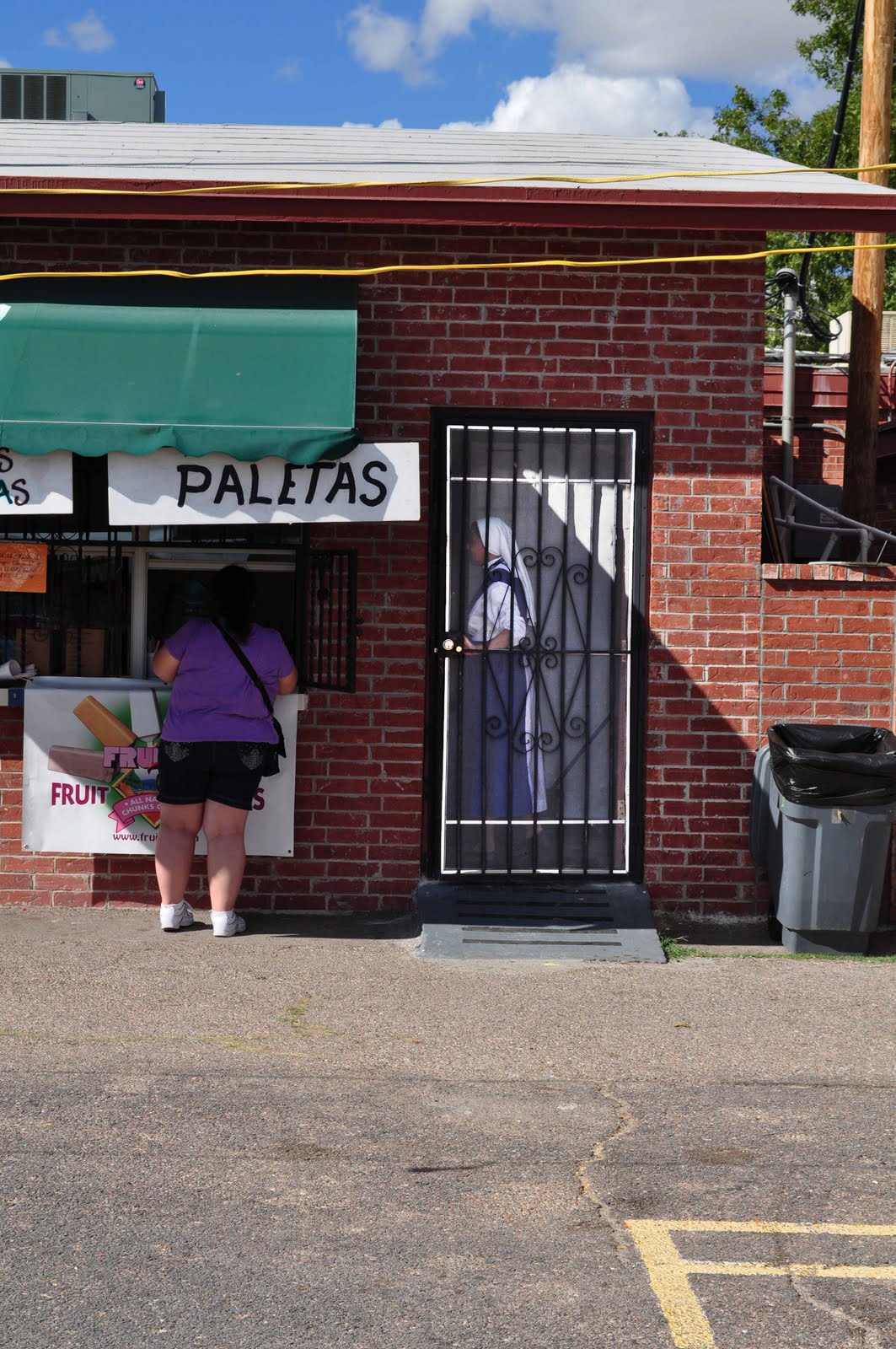
So it must be true.


El Diaro, the one that serves El Paso/Ciudad Juraez, reports that a life is worth four pennies.


Which life I wonder.

Las Adelitas


¡Ajúa!

Wednesday, November 3, 2010

Ask? Don't tell?

When I walk around the city shooting street photography, I am often stuck by people I see, so, of course, I want to take their picture.


In El Paso the people are so beautiful I cannot help but to want to preserve an image of everyone one, to keep in my heart forever.


But like most writers (remember, I am a fiction writer first), I love to people-watch. Ever since I was a child growing up in Fresno, I loved sitting downtown on the Fulton Mall watching all the ladies shopping, all the old men on the benches by the fountains, the cholo kids zipping by on their bicycles.

As an adult one of the things I love most about travelling is sitting in plazas or thoroughfares watching people walk by, people who strike me as beautiful.

Like these ladies going down an elevator.
Maybe what compelled me to shoot them was how well they were framed inside that metal box.

They saw me, and they clearly know I was taking their picture.

What I usually do when I’m caught snatching someone’s soul is shoot more shots right at them, and to the side of them, and way above their heads, so many shots, click click click, that they know I’m not singularizing them but am merely taking pictures of the city. And in most big cities, places like NYC or LA, so many people carry cameras, I am never out of place.


One of the issues one encounters in taking street photography is how to shoot people. The photo blogs offer many hints on how to take people’s photos on the sly, so one can get real candid shots.


Whereas I appreciate the effect of clandestine shots, I also think asking strangers if you can take their picture works as well.

It started one evening in Hollywood. I had been taking candid shots of people, when I decided I was going to ask people if I could take their pictures, just to see what reaction I got.


It surprised me that mostly everyone said yes.


I liked that I was able to focus my energy on only people who said yes.


In the photo below, I didn't notice the guy looking out the window until later. Click on it to see that single eye looking out from under the cap, which gives the image a bit of tension, I think.


So for now, asking people seems a good way to go, but not telling seems pretty good too.

Ask? Don't tell?

To ask:


Or not to ask?


To ask:


Or not to ask:


I guess it depends on the moment.

I think form in any work of art is much more effective when it is at least partially the result of the process of creation itself.

Like Borges says , If you have written what you set out to write, it's probably not worth much.

Monday, October 18, 2010

On An Ordinary Day in El Chuco


It was Sunday, and I admit, I'm stealing the title of this blog entry from a great book by Willis Barnstone called On an Ordinary Evening in Buenos Aires, in which he walked around the city with Borges, charlando, charlando, the labyrinth that Geogie loved best.

Andres Montoya too. He loved walking the city of Fresno in conversation, observing the city, looking closely into himself, speaking his heart to his evening's companion, seeing how he was created in the image of the city and how the universe was created in his image.

So one afternoon (many afternoons) I walked around El Chuco with my camera.

I paused before doorways and windows.


and got caught in. . .


"TrafiC"

(okay, maybe that transition was a bit sophomoric)


"Breaking, the Aztecs"


"Girl Eater"


"Dos Mujeres"


"The Girl, Watching, Watching."


"Dos Danzantes"


"Chicana Journalist"


"Kid"


Good night, Juarez.
We love you so much it hurts.